what factors contributed to the rise of nationalism in the 1810s

From elevation left, clockwise: The Battle of Waterloo signified the stop of Napoleon's conquests, as it sealed the downfall of his empire and brought his campaigns to an end; The French invasion of Russia and the subsequent retreat from Russia'due south harsh wintertime proved to be a turning point in the Napoleonic Wars, as food shortages and drastic supply loss led to catastrophic French losses from which Napoleon would never recover; The stethoscope was invented – its commencement paradigm made by Frenchman René Laennec could be shown hither. His invention proved to be an innovation that changed the course of medical diagnosis and overall medicinal sciences; Mount Tambora's eruption in 1815 – the world's largest volcanic eruption in recorded history – inflicted over ninety,000 human deaths, a cycle of famines, and a series harsh winters over the next few years, in a menstruation that would exist known as the Year Without a Summer. Its global impact had arguably made its eruption the world'due south most influential –and worst– volcanic eruption on contemporary history; - War of 1812 was fought over Canada and the U.S, and largely involved the struggle between remnants of British imperialism on the continent, with the and so-fledgeling nationalist movements that sprung as the aftermath of the American Revolutionary State of war and the The states' independence. It is widely considered equally a spillover political disharmonize of the Napoleonic Wars; The Great Comet of 1811 fabricated a brief appearance. Observations made past amateur scientists evolved modern-24-hour interval agreement of comets, and eventually forged a way for astronomy knowledge; Theory of Colours was first published. The German-fabricated theory helped inspire countless of visual arts and design concepts in the future, as well every bit nurturing farther understanding on colours; The gas light becomes widely implemented into urban systems – mainly as streetlights – afterwards its inception on the 1800s.
The 1810s (pronounced "eighteen-tens") was a decade of the Gregorian calendar that began on January 1, 1810, and ended on December 31, 1819.
The decade was opened with a very hostile political climate around the globe. Napoleon was invading French republic's neighbours in efforts to build a French Empire, causing a concatenation of global-scaled conflicts known every bit the Napoleonic Wars. Here, France's Napoleonic empire saw its rising and fall through events such equally Napoleon'southward attempts to conquer Russia, the War of 1812 (spillover to America), and the Boxing of Waterloo (Napoleon's ultimate defeat). Imperialism began to encroach towards African and Asian territories through trade, as the The states saw mass-scaled migration that headed westward towards the American frontier (mostly through the opening of the Oregon Trail.)
Politics and wars [edit]
Napoleonic Wars [edit]

In 1810, the French Empire reached its greatest extent. On the continent, the British and Portuguese remained restricted to the expanse effectually Lisbon and to besieged Cadiz. Napoleon married Marie-Louise, an Austrian Archduchess, with the aim of ensuring a more than stable alliance with Austria and of providing the Emperor with an heir. As well as the French Empire, Napoleon controlled the Swiss Confederation, the Confederation of the Rhine, the Duchy of Warsaw and the Kingdom of Italy. Territories centrolineal with the French included: the Kingdom of Spain, the Kingdom of Westphalia, the Kingdom of Naples, the Principality of Lucca and Piombino, and Napoleon's erstwhile enemies, Prussia and Austria. Denmark–Norway as well allied with France in opposition to Britain and Sweden in the Gunboat War.
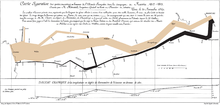
The French invasion of Russia of 1812 was a turning indicate, which reduced the French and allied invasion forces (the Grande Armée) to a tiny fraction of their initial force and triggered a major shift in European politics, as it dramatically weakened the previously dominant French position on the continent. After the disastrous invasion of Russian federation, a coalition of Republic of austria, Prussia, Russia, Sweden, the Great britain, and a number of High german States, and the rebels in Spain and Portugal united to battle France in the War of the Sixth Coalition. 2-and-a-half meg troops fought in the disharmonize and the total dead amounted to equally many as two million. This era included the battles of Smolensk, Borodino, Lützen, Bautzen, and the Dresden. It also included the ballsy Boxing of Leipzig in October, 1813 (also known as the Battle of Nations), which was the largest battle of the Napoleonic wars, which collection Napoleon out of Frg.

The final stage of the State of war of the Sixth Coalition, the defence force of French republic in 1814, saw the French Emperor temporarily repulse the vastly superior armies in the Six Days Campaign. Ultimately, the Allies occupied Paris, forcing Napoleon to forsake and restoring the Bourbons. Napoleon was exiled to Elba. Too in 1814, Kingdom of denmark–Norway was defeated past United kingdom and Sweden and had to cede the territory of mainland Kingdom of norway to the King of Sweden at the Treaty of Kiel.
Napoleon presently returned from exile, landing in France on March one, 1815, marking the State of war of the Seventh Coalition, heading toward Paris while the Congress of Vienna was sitting. On March 13, seven days before Napoleon reached Paris, the powers at the Congress of Vienna declared him an outlaw; 4 days afterward the United kingdom of great britain and northern ireland, Russia, Republic of austria and Prussia, members of the Seventh Coalition, spring themselves to put 150,000 men each into the field to finish his rule.[1] This set the stage for the last disharmonize in the Napoleonic Wars, the defeat of Napoleon at the Battle of Waterloo, the restoration of the French monarchy for the 2d time and the permanent exile of Napoleon to the distant isle of Saint Helena, where he died in May 1821.
Castilian American wars of independence [edit]
Espana in the 1810s was a state in turmoil. Occupied by Napoleon from 1808 to 1814, a massively destructive "war of independence" ensued, driven by an emergent Castilian nationalism. Already in 1810, the Caracas and Buenos Aires juntas declared their independence from the Bonapartist authorities in Spain and sent ambassadors to the United Kingdom. The British blockade against Spain had besides moved most of the Latin American colonies out of the Castilian economic sphere and into the British sphere, with whom extensive merchandise relations were developed. The remaining Castilian colonies had operated with virtual independence from Madrid after their pronouncement confronting Joseph Bonaparte.
The Spanish government in exile (Cortes of Cádiz) created the showtime modernistic Castilian constitution. Nonetheless, agreements made at the Congress of Vienna (where Spain was represented past Pedro Gómez Labrador, Marquis of Labrador) would cement international support for the sometime, absolutist government in Espana.
King Ferdinand VII, who assumed the throne after Napoleon was driven out of Spain, refused to concur to the liberal Spanish Constitution of 1812 on his accretion to the throne in 1814. The Spanish Empire in the New World had largely supported the crusade of Ferdinand 7 over the Bonapartist pretender to the throne in the midst of the Napoleonic Wars. When Ferdinand'southward rule was restored, these juntas were cautious of abandoning their autonomy, and an alliance betwixt local elites, merchant interests, nationalists, and liberals opposed to the abrogation of the Constitution of 1812 rose upwards against the Castilian in the New World.

The arrival of Spanish forces in the American colonies began in 1814, and was briefly successful in restoring central command over large parts of the Empire. Simón Bolívar, the leader of revolutionary forces in New Granada, was briefly forced into exile in British-controlled Jamaica, and contained Haiti. In 1816, however, Bolivar found enough popular support that he was able to return to South America, and in a daring march from Venezuela to New Granada (Colombia), he defeated Castilian forces at the Battle of Boyacá in 1819, ending Castilian rule in Colombia. Venezuela was liberated June 24, 1821, when Bolivar destroyed the Spanish army on the fields of Carabobo on the Boxing of Carabobo. Argentina declared its independence in 1816 (though it had been operating with virtual independence as a British client since 1807 after successfully resisting a British invasion). Chile was retaken by Spain in 1814, just lost permanently in 1817 when an army under José de San Martín, for the first time in history, crossed the Andes Mountains from Argentina to Chile, and went on to defeat Spanish royalist forces at the Battle of Chacabuco in 1817.
Spain would also lose Florida to the United states of america during this decade. Get-go, in 1810, the Republic of West Florida declared its independence from Spain, and was rapidly annexed past the United States. Later on, in 1818, the United States invaded Florida, resulting in the Adams-Onís Treaty, wherein Spain ceded the residual of Florida to the United states.
In 1820, Mexico, Republic of peru, Ecuador, and Central America even so remained nether Castilian command. Although Mexico had been in defection in 1811 under Miguel Hidalgo y Costilla, resistance to Spanish rule had largely been confined to small guerrilla bands in the countryside. King Ferdinand was still dissatisfied with the loss of and so much of the Empire and resolved to retake it. A large trek was assembled in Cadiz with the aim of reconquest. However, Ferdinand's plans would be disrupted by Liberal Revolution, and Ferdinand was somewhen forced to give up all of the New World colonies, except for Cuba and Puerto Rico.
State of war of 1812 [edit]
In 1812, the United States declared war on Britain in the War of 1812. The U.S. reasons for war included the humiliation in the "Chesapeake incident" of 1807, continued British impressment of American sailors into the Royal Navy, restrictions on trade with France, and arming hostile American Indians in Ohio and the western territories.[2] United States President James Madison signed a declaration of state of war on June 18, 1812.
The United States conducted two failed invasion attempts in 1812, commencement by General William Hull beyond the Detroit River into what is now Windsor, Ontario, and a second offensive at the Niagara peninsula. A major American success came in 1813, when the American Navy destroyed the British fleet on Lake Erie, and forced the British and their American Indian allies to retreat dorsum toward Niagara.[3] They were intercepted and destroyed by General William Henry Harrison at the Battle of the Thames in October 1813. Tecumseh, the leader of the tribal confederation, was killed, and his Indian coalition disintegrated.[4]
At sea, the powerful Royal Navy blockaded much of the coastline, conducting frequent raids. The well-nigh famous episode was a serial of British raids on the shores of Chesapeake Bay, including an assail on Washington that resulted in the British burning of the White House, the Capitol, the Navy Thousand, and other public buildings, in the "Burning of Washington" in 1814.
One time Napoleon was defeated in 1814, French republic and Britain became allies and Britain ended the merchandise restrictions and the impressment of American sailors. Running out of reasons for war and stuck in a military stalemate, the two countries signed the Treaty of Ghent on December 24, 1814. News of the peace treaty took two months to attain the U.South., during which fighting continued. In this acting, the British made one last major invasion, attempting to capture New Orleans, but were decisively defeated with very heavy losses by General Andrew Jackson at the Battle of New Orleans in January 1815. The ending of the war opened a long era of peaceful relations between the United States and the British Empire.
1804–1813 Russo-Farsi War [edit]
The 1804–1813 Russo-Persian State of war was one of the many wars between the Persian Empire and Imperial Russia, and was well underway at the beginning of the decade. In 1810, the Persians scaled upward their efforts late in the war, declaring a holy war on Majestic Russia. However, Russia's superior engineering and tactics ensured a series of strategic victories. Even when the French were in occupation of the Russian capital letter Moscow, Russian forces in the south were not recalled but connected their offensive against Persia, culminating in Pyotr Kotlyarevsky'southward victories at Aslanduz and Lenkoran, in 1812 and 1813 respectively. Upon the Persian surrender, the terms of the Treaty of Gulistan ceded the vast bulk of the previously disputed territories to Majestic Russia. This led to the region'south once-powerful khans being decimated and forced to pay homage to Russian federation.
Concert of Europe [edit]
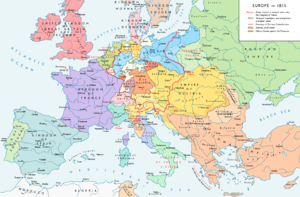
Past 1815, Europe had been almost constantly at war. During this time, the war machine conquests of France had resulted in the spread of liberalism throughout much of the continent, resulting in many states adopting the Napoleonic code. Largely as a reaction to the radicalism of the French Revolution,[5] the victorious powers of the Napoleonic Wars resolved to suppress liberalism and nationalism, and revert largely to the status quo of Europe prior to 1789.[6]
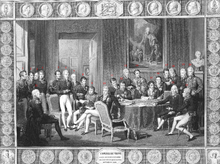
The result was the Concert of Europe, also known as the "Congress Organization". It was the balance of power that existed in Europe from 1815 until the early 20th century. Its founding members were the United Kingdom, Austrian Empire, Russian Empire and Kingdom of Prussia, the members of the Quadruple Alliance responsible for the downfall of the First French Empire; in fourth dimension France became established as a fifth member of the concert. At beginning, the leading personalities of the organisation were British foreign secretary Lord Castlereagh, Austrian chancellor Klemens Wenzel, Prince von Metternich and Tsar Alexander I of Russia.
The Kingdom of Prussia, Austrian Empire and Russian Empire formed the Holy Alliance with the expressed intent of preserving Christian social values and traditional monarchism.[7] Every member of the coalition promptly joined the Alliance, save for the Britain.
Amid the meetings of the Powers in the latter role of the 1810s were the Congresses of Vienna (1814–1815), Aix-la-Chappelle (1818), and Carlsbad (1819).
Other political events [edit]
Australia [edit]
- Black State of war (1804–1835)
- Hawkesbury and Nepean Wars (1795-1816)
Asia [edit]
- 1810: Ching Shih and Chang Pao surrender their pirate armada to the Chinese government.
- 1810: Russia acquires Sukhumi through a treaty with the Abkhazian dukes, and declares a protectorate over the whole of Abkhazia.
- Russo-Turkish State of war (1806–1812)
- May 28, 1812 – Russian Field Marshal Mikhail Kutuzov signs the Treaty of Bucharest, ending the Russo-Turkish War, 1806–1812 and making Bessarabia a function of Imperial Russia.
- October 31, 1817 – Emperor Ninkō accedes to the throne of Nippon.
- 1818: The 3rd Anglo-Maratha War is fought between the Marathas and the British Due east India Visitor troops resulting in the defeat of the Peshwa, the breakup of the Maratha Empire, and the loss of Maratha independence to the British as they annexed Central India. The last Peshwa is exiled to Bithur most Kanpur. His adopted son and heir Nana Saheb was one of the principal revolutionary commanders in the Indian Mutiny.
Europe [edit]
- August 21, 1810 – Jean-Baptiste Bernadotte, Marshal of French republic, is elected Crown Prince of Sweden past the Swedish Riksdag of the Estates.
- September 26, 1810 – A new Human action of Succession is adopted by the Riksdag of the Estates and Jean Baptiste Bernadotte becomes heir to the Swedish throne.
- October 12, 1810 – Commencement Oktoberfest: The Bavarian royalty invites the citizens of Munich to join the celebration of the union of Crown Prince Ludwig of Bavaria to Princess Therese of Saxe-Hildburghausen.
- Feb 5, 1811 – British Regency: George, Prince of Wales becomes Prince Regent because of the perceived insanity of his male parent, King George Iii of the Great britain.
- September, 1811 – Nathan of Breslov leads the first annual Rosh Hashana kibbutz (pilgrimage) of Breslov Hasidim to the grave of Rabbi Nachman of Breslov in Uman, Ukraine.
- January i, 1812 – The Allgemeines bürgerliches Gesetzbuch (the Austrian ceremonious code) enters into force in the Austrian Empire.
- May 11, 1812 – John Bellingham assassinates British Prime Government minister Spencer Perceval in the anteroom of the British House of Commons.
- July eighteen, 1812 – Russian federation'south Patriotic War, 1812 – Battle of Klyastitsy: Kulnev defeats Oudinot just sustains a mortal wound.
- October 18–Oct twenty, 1812 – Second Boxing of Polotsk – Russian federation
- December 30, 1812 – Convention of Tauroggen was signed.
- 1812 – The capital of Finland is moved from Turku to Helsinki.
- Nov ten, 1813 – A general ballot in the United Kingdom sees victory for the Tory Party under Robert Jenkinson, 2d Earl of Liverpool.
- 1813 – George Hamilton-Gordon serves as administrator extraordinaire in Vienna.
- Norway in 1814
- January 14, 1814 – Denmark cedes Kingdom of norway to Sweden in exchange for west Pomerania, as part of the Treaty of Kiel.
- February eleven, 1814 – Norway'south independence is proclaimed, mark the ultimate stop of the Kalmar Union.
- April 12, 1814 – The Royal Norwegian Navy is re-established.
- May 17, 1814 – The Constitution of Norway is signed and the Danish Crown Prince Christian Frederik is elected King of Norway past the Norwegian Constituent Associates.
- May 3, 1814 – The Duke of Provence, the future Louis Xviii of French republic, returns to Paris.
- May 17, 1814 – The occupation of Monaco changes from French to Austrian hands.
- May xxx, 1814 – The First Treaty of Paris is signed returning French republic's borders to their 1792 extent. Napoleon I of France is exiled to Elba on the same day.
- August 12, 1814 – In England, the last hanging nether the Blackness Act is carried out, of William Potter for cutting down an orchard (fifty-fifty the gauge petitioned for reprieve).
- Baronial 13, 1814 – The Anglo-Dutch Treaty of 1814 is signed.
- January three, 1815 – Austria, Uk, and Bourbon-restored France grade a secret defensive alliance treaty against Prussia and Russia.
- March fifteen, 1815 – Joachim Murat, Male monarch of Naples declares war on Austria in an attempt to save his throne, starting the Neapolitan War.
- March 16, 1815 – William I becomes King of kingdom of the netherlands.
- Apr 23, 1815 – The Second Serbian Uprising against Ottoman rule takes place in Takovo, Serbia. Past the end of the year Serbia is acknowledged as a semi-independent land; the ethics of the Starting time Serbian Uprising have thus been temporarily achieved.
- May 3, 1815 – Battle of Tolentino: Republic of austria defeats the Kingdom of Naples, which quickly ends the Neapolitan War. Joachim Murat, the defeated Rex of Naples, is forced to flee to Corsica and is later executed.
- 1815: In Britain, use of the pillory is limited to penalty for perjury.
- January 1, 1816 – Tsar Alexander I of Russian federation signs an order for the expulsion of the Jesuits from the Russian Empire.
- March 25, 1816 – Friedrich Karl Ludwig, Duke of Schleswig-Holstein-Sonderburg-Brook dies and is succeeded by the later Friedrich Wilhelm, Knuckles of Schleswig-Holstein-Sonderburg-Glücksburg, his son and founder of the Schleswig-Holstein-Sonderburg-Glücksburg.
- 1816: The Senate of Republic of finland is established.
- 1816: The Ottomans grant Serbia local autonomy.
- April three, 1817 – Princess Caraboo appears in Almondsbury in Gloucestershire, England.
- May eleven, 1818 – Charles XIV of Sweden-Norway is crowned king of Sweden.
- September vii, 1818 – Carl III of Sweden-Kingdom of norway is crowned rex of Norway, in Trondheim.
- September 23, 1818 – Border markers are formally installed for the European territory of Moresnet.
- September 20, 1819 – The Carlsbad Decree is issued throughout the German Confederation.
Africa [edit]
- 1810: Amadou Lobbo initiates his jihad in nowadays-24-hour interval Republic of mali.
- 1810: The Boxing of Vieux Yard Port (Great Former Port) in the Indian Sea, off the declension of the Island of Mauritius, was the simply naval victory won by Napoleon. This battle has very often been ignored by scholars, simply was of keen importance for the control of the Indian Sea as a trade route between Europe and the East.
- March ane, 1811 – Citadel Massacre: Egyptian ruler Mohammed Ali kills the terminal Mamluk leaders.
- 1813: Following the death of his father Wossen Seged, Sahle Selassie arrives at the capital Qundi earlier his other brothers, and is made Méridazmach of Shewa.
- 1816: Banjul, capital of the Republic of the gambia, is founded every bit a trading post, and named Bathurst.
- Baronial 27, 1816 – Bombardment of Algiers: Various European Allie ships forcefulness the Dey of Algiers to free Christian slaves.
- 1818: Shaka starts to rule.
- Mtetwa Empire Expansion
Northward America [edit]
- May 1, 1810 – Macon's Bill Number 2 becomes law.
- June 4, 1810 – The Society in Dedham for Apprehending Horse Thieves is founded in Dedham, Massachusetts.
- 1811: The Ruby River Colony is founded in Manitoba, Canada.
- March 22, 1811 – The Commissioners' Plan of 1811 for Manhattan is presented.
- November 6, 1811 – Battle of Tippecanoe: American troops led by William Henry Harrison defeat the Native American principal Tecumseh.
- February 11, 1812 – Massachusetts governor Elbridge Gerry invents gerrymandering.
- April iv, 1812 – U.S. President James Madison enacts a 90-day embargo on merchandise with the United Kingdom.
- April 30, 1812 – Louisiana is admitted as the 18th U.Due south. country.
- June 4, 1812 – Following Louisiana'due south admittance as a U.S. state, the territory by that proper name is renamed the Missouri Territory.
- October 1812 – The capital of the Commonwealth of Pennsylvania, United states is permanently moved from Lancaster to Harrisburg.
- November 5, 1812 – James Madison defeats DeWitt Clinton in the U.S. presidential election.
- March 27, 1814 – Creek War – Battle of Horseshoe Bend: In northern Alabama, United States forces under General Andrew Jackson defeat the Creek Indians.
- December 15, 1814 – The Hartford Convention is convened past members of the American Federalist Party.
- February – The Hartford Convention arrives in Washington, D.C..
- August 24, 1816 – The Treaty of St. Louis is signed in St. Louis, Missouri.
- Nov 6, 1816 – James Monroe defeats Rufus Rex in the U.S. presidential election.
- December 11, 1816 – Indiana is admitted every bit the 19th U.S. land.
- 1816: The Second Banking concern of the The states obtains its charter.
- The Era of Good Feelings (1816–1823/1824) in the U.S.
- March 3
- President James Madison vetoes John C. Calhoun's Bonus Bill.
- U.South. Congress passes law to separate the Mississippi Territory, after Mississippi drafts a constitution, creating the Alabama Territory effective in Baronial.[8]
- March four, 1817 – James Monroe succeeds James Madison every bit President of the United States of America.
- April 29, 1817 – The Blitz–Bagot Treaty is signed.
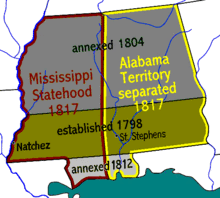
- August fifteen, 1817 – By human activity of the U.S. Congress (March 3), the Alabama Territory is created by splitting the Mississippi Territory in half, on the day the Mississippi constitution is drafted, iv months before Mississippi becomes a U.South. country.[viii]
- November xx, 1817 – The First Seminole State of war begins in Florida.
- December 10, 1817 – Mississippi is admitted as the 20th U.S. state, formerly the Mississippi Territory.[8]
- Apr iv, 1818 – The U.Southward. Congress adopts the flag of the Us as having 13 red and white stripes and one star for each state (xx stars) with boosted stars to exist added whenever a new country is added to the Union.
- August 1, 1818 – Carve up Topographical Bureau of the War Department.
- Oct 20, 1818 – The Treaty of 1818 between the Usa and the Great britain establishes the northern boundary as the 49th parallel from the Lake of the Woods to the Rocky Mountains, also creating the Northwest Angle.
- December 3, 1818 – Illinois is admitted as the 21st U.Due south. country.
- Feb 2, 1819 – The Supreme Court under John Marshall rules in favor of Dartmouth College in the famous Dartmouth College five. Woodward instance, allowing Dartmouth to keep its charter and remain a private establishment.
- March 6, 1819 – McCulloch v. Maryland: The U.S. Supreme Court rules that the Bank of the The states is constitutional.
- 1819: The ʻAi Noa movement takes power in Hawaii.
- The city of Fernandina of Jagua (afterward Cienfuegos City) is founded in Cuba.
- Dec 14, 1819 – Alabama is admitted as the 22nd U.S. country.
South America [edit]
- 1814: Guyana is transferred from the Netherlands to Britain; it is renamed British Guiana.
- Baronial 22, 1817 – The city of Araraquara, Brazil is founded.
- The Spanish colony of New Granada declares independence as the Republic of Gran Colombia nether President Simón Bolívar (1800–1900)* Stars the period of Latin American revolutions. Several states declare their independence from Spain.
- 1817: The Pernambucan Defection breaks out in Brazil.
Commerce [edit]
Trading companies [edit]
- June 23, 1810 – John Jacob Astor forms the Pacific Fur Visitor.
- September viii, 1810 – The Tonquin sets canvass from New York Harbor with 33 employees of John Jacob Astor'due south newly created Pacific Fur Company on board. Subsequently a 6-month journey around the tip of Due south America, the ship arrives at the oral fissure of the Columbia River and Astor's men establish the fur-trading town of Astoria.
- 1810: Palm oil sales from West Africa to Britain achieve 1,000 tons.
- February 2, 1812 – Russia establishes a fur trading colony at Fort Ross, California.
- June xix, 1816 – Battle of Seven Oaks: The Hudson'due south Bay Company is defeated by the North West Fur-Trading Company, near Winnipeg, Manitoba, Canada.
- 1818: Lord Hastings, governor-general of Republic of india, gives approval to Sir Stamford Raffles to constitute trading station at the southern tip of the Malay Peninsula (mod-day Singapore).
- 1818: The British East India Visitor controls territory occupied past 180 1000000 Indians.
- January 29, 1819 – Sir Stamford Raffles lands on the isle of Singapore.
- Feb six, 1819 – A formal treaty between Hussein Shah of Johor and the British Sir Thomas Stamford Raffles establishes a trading settlement in Singapore.
Establishments [edit]
- 1812: The Quondam Oscar Pepper Distillery (now the Woodford Reserve Distillery), the oldest Kentucky Bourbon distillery, is established along Glenn's Creek in Woodford Canton, Kentucky.
- February three, 1815 – The first commercial cheese mill is founded in Switzerland.
- 1816: E. Remington and Sons (the famous firearm and subsequently typewriter manufacturing company) is founded.
- Apr 7, 1818 – Brooks Brothers, the oldest men'south clothier in the United States, opens its first store on the northeast corner of Catherine and Cherry Streets in New York City, where the Southward Street Seaport now stands.
- March xx, 1819 – Burlington Arcade opens in London.
Slavery, Serfdom and Labor [edit]
- 1810: Adult cotton fiber spinners phase a general strike in Manchester.
- 1810: xviii,000 Angolans are sold at Rio de Janeiro, Brazil.
- Jan 8, 1811 – An unsuccessful slave revolt is led by Charles Deslandes in St. Charles and St. James Parishes, Louisiana.
- March 23, 1816 – Estonia emancipates its peasants from serfdom.
- February 15, 1819 – The The states House of Representatives agrees to the Tallmadge Amendment barring slaves from the new country of Missouri (the opening vote in a controversy that leads to the Missouri Compromise).
- August 16, 1819 – Peterloo Massacre: The cavalry charges into a crowd of protesters in Manchester, UK, resulting in 11 deaths and over 400 injuries.
- 1819: Serfdom is abolished in Livonia.
Luddites [edit]
- The Luddites (1811–1816) in Britain were machine-wreckers, protesting against machines perceived as taking their jobs.
- November, 1811 – Luddite uprisings begin in northern England and the Midlands.
- February 27, 1812 – Poet Lord Byron gives his get-go address as a member of the House of Lords, in defense of Luddite violence against Industrialism in his home county of Nottinghamshire.
- March 15, 1812 – Luddites attack the wool processing factory of Frank Vickerman in West Yorkshire.
Economics [edit]
- February 21, 1814 – Bully Stock Exchange Fraud of 1814.
- January 2, 1819 – The Panic of 1819 (the first major financial crisis in the United States) begins.
Science and engineering science [edit]
- Gas lighting becomes a practical technology and is implemented in cities in Europe and the United States.
- June – Nicolas Appert publishes L'fine art de conserver pendant plusieurs années toutes les substances animales ou végétales, the first description of modernistic food preservation using closed containers
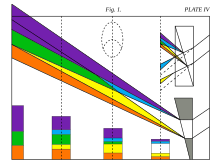
- 1810: Johann Wolfgang von Goethe publishes his Theory of Colours.
- July 11, 1811 – Italian scientist Amedeo Avogadro publishes his memoire about the molecular content of gases.
- Feb 12, 1812 – Napoleon authorizes the usage of "Mesures usuelles", a arrangement of measurement introduced as compromise between the metric organization and traditional French measurements. The system was restricted to apply in the retail industry and continued in use until 1840, when the laws of measurement from the 1795 and 1799 were reinstituted. (run across also: Units of measurement in France)
- 1813: Mathieu Orfila publishes his groundbreaking Traité des poisons, formalizing the field of toxicology.
- October 21, 1815 – Humphry Davy patents the miner'south safety lamp for utilize in coal mining.
- January 9, 1816 – Sir Humphry Davy tests the Davy lamp for Miners at Hebburn Colliery.
- 1816 – René Laennec invents the stethoscope.
- 1816 – Robert Stirling patents his Stirling engine, so known as Stirling's air engine.
- John Kidd extracts naphthalene from coal tar.
Astronomy [edit]
- March 25, 1811 – The Swell Comet of 1811 is discovered past Honoré Flaugergues.
- July 1, 1819 – Johann Georg Tralles discovers the Smashing Comet of 1819, (C/1819 N1). Information technology was the first comet analyzed using polarimetry, by François Arago.
Steamboats [edit]

"Enterprise on her fast trip to Louisville, 1815"
The 1810s continued a tendency of increasing commercial viability of steamboats in N America, post-obit the early success of Robert Fulton and others in the preceding years. In 1811 the get-go in a continuously operating line of river steamboats left the dock at Pittsburgh to steam downwards the Ohio River to the Mississippi and on to New Orleans.[9] Inventor John Stevens' boat, the Juliana, began operation as the first steam-powered ferry October eleven, 1811, with service betwixt New York, and Hoboken, New Jersey. John Molson's PS Accommodation was the starting time steamboat on the St. Lawrence and in Canada.[10] Unlike Fulton, Molson did not evidence a turn a profit. Molson had also two paddle steamboats "Swiftsure" of 1811 and "Malsham" of 1813 with engines by B&W.[11] The feel of these vessels, especially that they could now offering a regular service, being contained of wind and weather, helped brand the new system of propulsion commercially viable, and as a result its application to the more open waters of the Slap-up Lakes was side by side considered. That idea went on hiatus due to the State of war of 1812.
In a 25-day trip in 1815, the Enterprise further demonstrated the commercial potential of the steamboat with a ii,200-mile voyage from New Orleans to Pittsburgh.[12] [13] In 1817, a consortium in Sackets Harbor, New York, funded the structure of the first United states steamboat, Ontario, to run on Lake Ontario and the Great Lakes, beginning the growth of lake commercial and rider traffic.[14]
The showtime commercially successful steamboat in Europe, Henry Bell'south Comet of 1812, started a rapid expansion of steam services on the Firth of Clyde, and inside four years a steamer service was in operation on the inland Loch Lomond, a forerunner of the lake steamers yet gracing Swiss lakes. On the Clyde itself, within ten years of Comet's showtime in 1812 there were about fifty steamers, and services had started across the Irish Sea to Belfast and on many British estuaries. P.Due south."Thames", ex "Argyle" was the kickoff seagoing steamer in Europe, having steamed from Glasgow to London in May 1815.[15] P.S."Tug", the first tugboat, was launched by the Woods Brothers, Port Glasgow, on November five, 1817; in the summer of 1817 she was the first steamboat to travel circular the Due north of Scotland to the East Coast.[16]
The first steamship credited with crossing the Atlantic Ocean between N America and Europe was the American ship SS Savannah, though she was actually a hybrid betwixt a steamship and a sailing ship. The SS Savannah left the port of Savannah, Georgia, on May 22, 1819, arriving in Liverpool, England, on June 20, 1819; her steam engine having been in use for part of the time on eighteen days (estimates vary from eight to 80 hours).
Locomotives [edit]
- July 25, 1814 –George Stephenson tests his locomotive Blucher successfully.
- February 6, 1815 – New Jersey grants the kickoff American railroad lease to a John Stevens.
- 1816: A rails capable of supporting a heavy locomotive is developed.
Other transportation [edit]
- July iv, 1817 – At Rome, New York, construction on the Erie Canal begins.
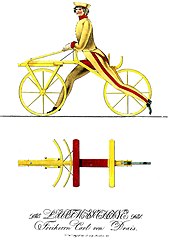
- 1818 - Baron Karl Drais patents the laufmaschine, a forerunner to the bicycle
Natural events [edit]
- December 16, 1811 – The New Madrid convulsion in Mississippi Valley almost New Madrid reverses the course of the river for a while. Other earthquakes along the error occur on January 23, 1812, and February seven, 1812.
- February 7, 1812 – The last New Madrid earthquake strikes New Madrid, Missouri, with an estimated moment magnitude of over 8;
- March 26, 1812 – An convulsion destroys Caracas, Venezuela.
- April, 1817 – An convulsion strikes Palermo, Italy.
- August 23, 1817 – An earthquake virtually the site of the ancient Greek city of Helike results in 65 deaths.
Year Without a Summer [edit]

- April 5–April 12, 1815 – Mount Tambora in the Dutch Eastward Indies blows its top explosively during an eruption, killing upwards of 92,000 and propelling thousands of tons of aerosols (Sulfide gas compounds) into the upper atmosphere (stratosphere). The post-obit year (1816) becomes known as "Yr Without a Summer", equally the high level gases reflect sunlight and cause the widespread cooling (known every bit a volcanic winter) and heavy rains, snows in June and July in the northern hemisphere, and widespread crop failures.
Culture [edit]
Literature [edit]
Lord Byron, regarded as one of the greatest British poets and remains widely read and influential, wrote his most well-known work during this decade. Amongst Byron's works are the brief poems She Walks in Beauty, When We Two Parted, and And so, nosotros'll go no more a roving, in add-on to the narrative poems Childe Harold's Pilgrimage and Don Juan.
Other events in literature:
- December 20, 1812 - The get-go volume of Grimm's Fairy Tales is published.
- Jan 28, 1813 – Jane Austen'southward Pride and Prejudice is published.
- September, 1813 – Robert Southey becomes Poet Laureate of Britain.
- 1813: The Philomathean Society of the University of Pennsylvania is founded (the oldest continuously existing literary society in the United States).
- 1814: Missionaries endeavour to write downward the Māori linguistic communication.
- 1814: Sir Walter Scott writes Waverley.
- 1816: Jane Austen's Emma is published.
- 1817: Samuel Taylor Coleridge publishes Biographia Literaria.
- Jan 1, 1818 – Mary Shelley'due south Frankenstein is published.
Manner [edit]
Theatre [edit]
- 1818: Former Vic founded (as Royal Coburg Hall).
Music [edit]
- April 27, 1810 – Beethoven composes his famous piano piece, Für Elise.
- January 24, 1813 – The Philharmonic Club founded in London (later the Purple Combo Social club).
- December 8, 1813 – Beethoven's seventh symphony is performed for the first fourth dimension in Vienna.
- Feb 27, 1814 – Beethoven'due south 8th symphony is performed for the first time in Vienna, less than iii months after his seventh symphony was start performed. Beethoven reportedly told one of his pupils that the seventh symphony was more pop because his 8th symphony was better.[17] It would be over ten years before the first performance of his adjacent symphony in Vienna.
- February 20, 1816 – Gioachino Rossini'south The Barber of Seville debuts at Teatro Argentine republic, with a fiasco.
- December 24, 1818 – Silent Night composed by Franz Xaver Gruber and Josef Mohr.
Other [edit]

- 1815: Commencement-form cricket begins.
- 1817: Elgin Marbles are displayed in the British Museum.
- 1818: The first edition of the Farmer's Almanac is published.
People [edit]
[edit]
- Mary Shelley (Frankenstein)
Disasters [edit]
- June 9, 1811 – The Great fire of the Podil breaks out in Kiev, Ukraine.
- May 25, 1812 – Felling mine disaster: A mine explosion at the Felling colliery near Jarrow, England, leaves 96 expressionless.
- Feb 12, 1814 – A burn down destroys the Custom House in London.
- October – A large vat full of porter (beer) owned by Meux'south Brewery of London bursts, demolishing houses and killing 9 people. See London Beer Flood.
- May 30, 1815 – The Arniston, an East Indiaman repatriating wounded troops to England from Ceylon, is wrecked near Waenhuiskrans, South Africa with the loss of 372 of the 378 people on lath.
- September 23, 1815 – The Swell September Gale of 1815 is the first hurricane to strike New England in 180 years.
- October 3, 1815 – The Chassigny Mars meteorite falls in Chassigny, Haute-Marne, France.
- Feb 12, 1816 – Fire almost destroys the city of St. John's, Newfoundland.
- July 17, 1816 – The French rider transport Medusa runs aground off the coast of Senegal, with 140 lives lost in the botched rescue that takes weeks, leading to a scandal in the French government.
- June 25, 1817 – A big riot breaks out in Copenhagen Prison; the army is sent to quell information technology.
- 1817 – A typhus epidemic occurs in Edinburgh and Glasgow.
Establishments [edit]
- 1812 – The Bishop James Madison Society is founded at the Higher of William & Mary, Williamsburg, Virginia.
- August vii, 1814 – Pope Pius VII decrees the bull Sollicitudo omnium ecclesiarum reestablishing the Society of Jesus (Jesuits) all over the world, after having approved their survival and beingness in Russia.
- February 4, 1815 – The first Dutch student association, the Groninger Studenten Corps, Vindicat atque Polit is founded in kingdom of the netherlands. The first rector of the senate was B.J. Wintertime.
- April xi, 1816 – In Philadelphia, the African Methodist Episcopal Church is established by Richard Allen and other African-American Methodists, the outset such denomination completely independent of White churches.
- 1816 – Rammohun Roy founds Hindu College in Calcutta, offering instructions in Western languages and subjects.
- April xv, 1817 – The showtime American school for the deaf opens in Hartford, Connecticut.
- May, 1817 – The General Convention of the Episcopal Church building founds the Full general Theological Seminary while coming together in New York City.
- Nov 11, 1818 – Anglo-Chinese Higher is founded by Robert Morrison in Malacca (later on renamed Ying Wa Higher).
- January 25, 1819 – Thomas Jefferson founds the University of Virginia.
- August 6, 1819 – Norwich Academy is founded by Captain Alden Partridge in Vermont as the first private military school in the United States.
Other events [edit]
- August 3, 1811 – First rise of Jungfrau, 3rd highest superlative in the Bernese Alps,
- July 13, 1813 – Missionaries Adoniram Judson and his wife Ann Hasseltine Judson make it in Burma.
- 1815 – British missionaries make it in New Zealand.
- 1815 – The second wave of Amish immigration to North America begins.
- 1816 – Tsultrim Gyatso becomes the 10th Dalai Lama.
- November 22, 1817 – Frédéric Cailliaud discovers the one-time Roman emerald mines at Sikait, Egypt.
References [edit]
 | Wikimedia Commons has media related to 1810s. |
- ^ Hamilton-Williams, David p. 59
- ^ Wood, Empire of Liberty (2009) ch 18
- ^ Heidler and Heidler, Encyclopedia of the State of war of 1812, pp 290-93
- ^ Hickey, War of 1812 p. 183
- ^ Wood, Empire of Liberty (2009), pg. 329.
- ^ Wood, Empire of Liberty (2009), pg 330.
- ^ Spahn, G. (1910). Holy Alliance. In The Catholic Encyclopedia. New York: Robert Appleton Visitor. Retrieved May 15, 2010, from New Advent.
- ^ a b c "An 1820 Claim to Congress: Alabama Territory : 1817", The Intruders, TNGenNet Inc., 2001, quick webpage: TN-537 [ permanent dead link ] .
- ^ [1] Archived September 27, 2007, at the Wayback Machine
- ^ "Canadian Encyclopedia", 2010.
- ^ Boulton & Watt Engine Order Book, Birmingham Public Library, England.
- ^ Western Courier [Louisville, Ky.], 1 June 1815: "Arrived in this port, in 25 days from New-Orléans, the Steam-Boat Enterprize, capt. SHRIEVE. The celerity and safety with which this gunkhole descends and ascends the currents of these mighty waters, the improvement of the navigation of which is then advantageous to the western earth, must be as interesting to the farmer and the merchant. The facility and convenience of the passage, in ascending the rivers, are such as to give a decided preference to this mode of navigation, while the size and structure of the boat entitles it to all the advantages which the Ætna and Vesuvius have in vain attempted to monopolize over the free waters of our common land."
- ^ American Telegraph [Brownsville, Pa.], 5 July 1815: "Arrived at this port on Monday last, the Steam Boat Enterprize, Shreve, of Bridgeport, from New Orleans, in ballast, having discharged her cargo at Pittsburgh. She is the offset steam boat that ever made the voyage to the Mouth of the Mississippi and back. She made the voyage from New Orleans to this port, in fifty four days, twenty days on which were employed in loading and unloading freight at different towns on the Mississippi and Ohio, so that she was only xxx four days in active service, in making her voyage, which our readers will retrieve must be performed against powerful currents, and is upwards of 2 one thousand two hundred miles in length."
- ^ Barlow Cumberland Archived 2005-02-06 at the Wayback Machine, A Century of Canvas and Steam on the Niagara River, 1911, accessed xx August 2010
- ^ John Kennedy,"The History of Steam Navigation" Liverpool,1903.
- ^ A.I.Bowman, "Swifts & Queens", Strathkelvin, 1983.
- ^ Steinberg, Michael. "The Symphony: a listeners guide". pp. 44–47. Oxford Academy Printing, 1995.
Source: https://en.wikipedia.org/wiki/1810s
0 Response to "what factors contributed to the rise of nationalism in the 1810s"
Post a Comment